
Thumb Rule for Heat Load Calculation: Fast & Reliable HVAC Sizing Guide
Proper HVAC sizing begins with understanding the cooling or heating demand of a space. In many real-world projects, engineers and technicians rely on the thumb rule for heat load calculation to get a quick yet practical estimate before moving to detailed software analysis. This approach saves time during planning, budgeting, and equipment selection, especially in early design stages.
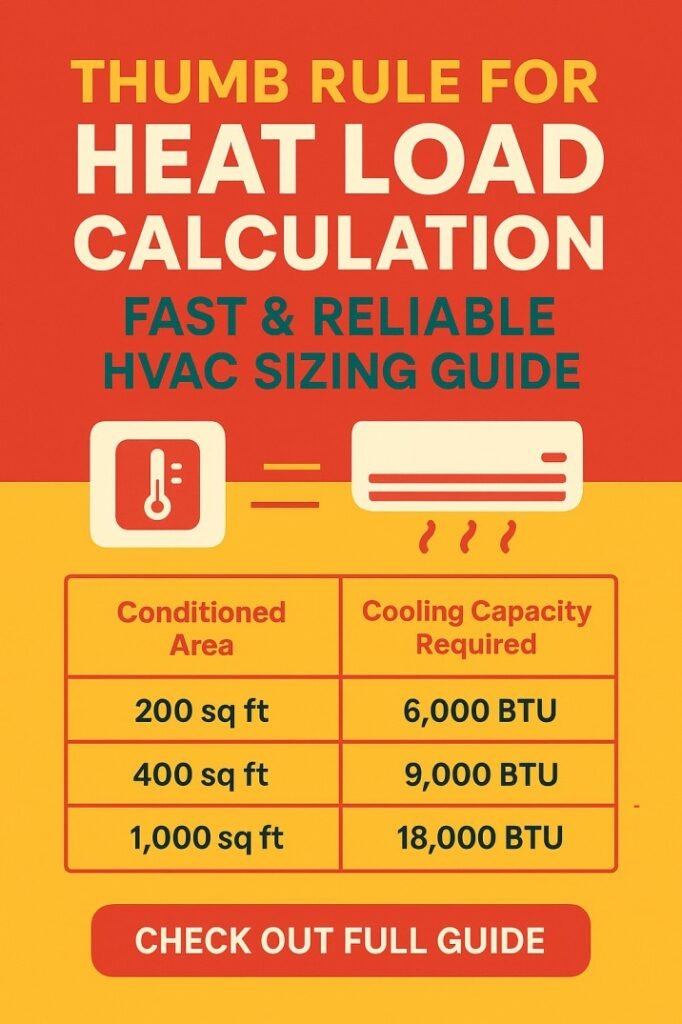
Table of Contents
The thumb rule for heat load calculation is not meant to replace detailed load modeling, but it offers a reliable starting point. When applied correctly, it prevents oversizing, reduces energy waste, and helps teams make faster technical decisions.
Know more about Benefits of VFD in HVAC Systems
What Is a Heat Load in HVAC?
Heat load refers to the total amount of heat that must be removed or added to maintain a comfortable indoor temperature. It includes heat from walls, roofs, windows, lighting, people, appliances, and ventilation air. Calculating this precisely requires detailed data, but the thumb rule for heat load calculation allows professionals to estimate capacity using simplified assumptions.
In practical HVAC work, this method is useful for feasibility studies, budget quotes, and early system sizing.
Why Professionals Use Thumb Rules
Detailed heat load calculations take time and accurate architectural data. During site visits or initial client discussions, those details are often unavailable. The thumb rule for heat load calculation provides a fast method to estimate tonnage or BTU requirements using floor area and building type.
Benefits include faster decision-making, reduced design delays, and easier communication with clients. It also helps technicians quickly check whether an existing unit is roughly sized correctly.
Know more about Electrical Panel Heat Load Calculation
Basic Thumb Rule Values by Building Type
Different spaces generate different internal heat gains. Residential rooms have fewer occupants and devices, while commercial spaces have lighting, equipment, and higher occupancy. That is why the thumb rule for heat load calculation varies by application.
| Building Type | Approx. Heat Load (BTU/hr per sq ft) | Approx. Tons per 500 sq ft |
|---|---|---|
| Residential Bedroom | 20–25 | 1 ton per 600–800 sq ft |
| Residential Living | 25–30 | 1 ton per 500–600 sq ft |
| Office Space | 30–35 | 1 ton per 400–500 sq ft |
| Retail Shop | 35–45 | 1 ton per 300–400 sq ft |
| Restaurant | 45–60 | 1 ton per 200–300 sq ft |
These values form the foundation of the thumb rule for heat load calculation used worldwide in preliminary HVAC sizing.
Know more about NEC Article 440: HVAC Equipment Rules Most Electricians Miss
Simple Formula Using Floor Area
A common way to apply the thumb rule for heat load calculation is through this basic formula:
Cooling Load (BTU/hr) = Area (sq ft) × BTU factor
For example, if an office measures 1,000 sq ft and the factor is 30 BTU/hr per sq ft:
1,000 × 30 = 30,000 BTU/hr
Since 1 ton of cooling equals 12,000 BTU/hr:
30,000 ÷ 12,000 = 2.5 tons
This quick estimate gives a starting point before detailed HVAC load analysis.
Adjustments That Improve Accuracy
While the thumb rule for heat load calculation is simple, small adjustments can make it more reliable.
| Condition | Adjustment Recommendation |
|---|---|
| Top floor under roof | Add 10% |
| Large glass windows | Add 10–15% |
| Poor insulation | Add 10% |
| High occupancy | Add 5–10% |
| Shaded building | Reduce 5% |
These corrections help bridge the gap between rough estimation and real operating conditions.
Climate Matters a Lot
Geographic location strongly affects HVAC sizing. Hot and humid regions require higher cooling capacity than mild climates. When applying the thumb rule for heat load calculation, professionals often increase the BTU factor for tropical zones and reduce it in cooler regions.
For example, a residential space in a hot climate may use 30 BTU per sq ft instead of 22 BTU. This ensures the air conditioning system can handle peak summer loads.
Find out our guide on Thumb Rule for HVAC Load Calculation
Occupancy and Internal Heat Gains
People, lights, and equipment generate heat continuously. Offices with computers, printers, and lighting fixtures produce more heat than homes. That is why the thumb rule for heat load calculation for commercial buildings uses higher values.
Here is a quick reference for internal heat gains:
| Heat Source | Typical Contribution |
|---|---|
| One person | 400–600 BTU/hr |
| Desktop computer | 250–400 BTU/hr |
| Lighting (per watt) | 3.4 BTU/hr |
| Office equipment | 500–1,500 BTU/hr |
Adding these loads gives a clearer picture when estimating system size.
Ventilation and Fresh Air Load
Fresh air is required for indoor air quality, but it adds to cooling demand. Outdoor air is usually warmer and more humid. Even when using the thumb rule for heat load calculation, professionals consider ventilation for offices, halls, and commercial spaces.
A quick estimate is to add 10–20% extra capacity where mechanical ventilation is high. This prevents undersizing and ensures comfort during peak occupancy.
Learn all about Remote Monitoring Solutions for HVAC Automation USA
Common Mistakes When Using Thumb Rules
The thumb rule for heat load calculation works best when used wisely. Problems arise when people apply residential values to commercial spaces or ignore building orientation.
Oversizing is another common issue. Bigger equipment costs more, cycles frequently, and wastes energy. Undersizing leads to poor comfort and constant operation. The thumb rule should guide early sizing, not replace detailed design.
When to Move Beyond Thumb Rules
While the thumb rule for heat load calculation is useful, detailed software calculations are necessary for large or critical projects. Hospitals, data centers, laboratories, and high-rise buildings require precise modeling of solar gains, infiltration, equipment loads, and humidity control.
Explore our professional online tool for quick calculations kw to cable size calculator
Still, even in these cases, thumb rules help verify whether software results are realistic. If detailed results are very different from thumb estimates, it signals a need to recheck inputs.
Practical Example for Quick Estimation
Consider a small retail store of 800 sq ft in a warm city. Retail spaces typically use 40 BTU per sq ft under the thumb rule for heat load calculation.
800 × 40 = 32,000 BTU/hr
32,000 ÷ 12,000 = 2.67 tons
Rounding up, a 3-ton air conditioner would be selected at the budgeting stage. Later, a detailed calculation may refine this value.
Final Thoughts on Fast HVAC Sizing
The thumb rule for heat load calculation remains one of the most practical tools in HVAC engineering. It allows fast system sizing, supports early project discussions, and helps avoid major estimation errors. When combined with professional judgment and small correction factors, it delivers surprisingly reliable results.
However, it should always be followed by proper engineering calculations for final equipment selection. Used the right way, thumb rules save time, reduce guesswork, and support smarter HVAC design decisions.
You might find this tool useful for tackling similar tasks Sub Panel Wire Size Calculator – Accurate Wire Gauge & Load Sizing Tool
Follow Us on Social:
Subscribe our Newsletter on Electrical Insights for latest updates from Electrical Engineering Hub
#HeatLoadCalculation, #HVACDesign, #CoolingLoad, #MechanicalEngineering, #BuildingServices, #ThermalLoad, #HVACTips, #EngineeringBasics, #EnergyEfficiency, #MEPDesign