Skip to content
Electrical Engineering Hub

Electrical Engineering Hub

  • Home
  • Blog
  • Electrical Standards
  • Electrical ToolsExpand
    • Cables Tools
    • Transformer Tools
    • Generator Tools
    • Electronics Tools
  • Guest Post
  • Advertise
Linkedin Facebook Twitter Pinterest Medium
Linkedin Facebook Twitter Pinterest
Electrical Engineering Hub

EU Flags Chinese Solar Technology as Potential Security Risk Amid Rising Energy Infrastructure Concerns

Home - News - Chinese Solar Technology

The European Union is increasingly raising alarms over the growing dependence on Chinese-made solar technology, warning that key components used in renewable energy systems could pose a significant cybersecurity and infrastructure security risk. The concern is centered on the possibility that critical solar equipment, particularly inverters and connected digital systems, may be vulnerable to remote interference, potentially affecting Europe’s power grids.
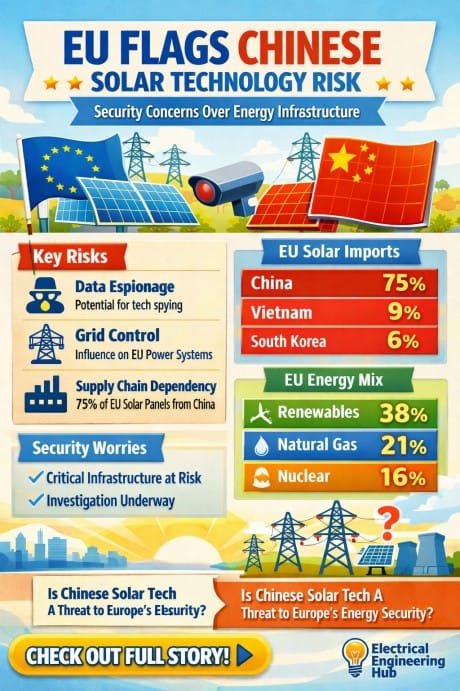
EU Flags Chinese Solar Technology as Potential Security Risk Amid Rising Energy Infrastructure Concerns

As Europe continues its rapid transition toward renewable energy, solar power has become one of the fastest-growing sources of electricity generation. However, much of the underlying hardware—especially solar panels, inverters, and monitoring systems—is manufactured in China. This heavy reliance has sparked debate among policymakers and security experts who fear that energy infrastructure could be exposed to external control or disruption.

At the heart of the issue are solar inverters, which are essential devices that convert solar energy into usable electricity for homes, businesses, and the grid. Modern inverters are increasingly “smart,” meaning they are connected to the internet for performance monitoring, maintenance updates, and remote management. While this connectivity improves efficiency and reduces operational costs, it also introduces potential cybersecurity vulnerabilities.

European officials and security analysts have warned that if these systems are compromised, they could theoretically be manipulated to disrupt electricity flows or even destabilize parts of national grids. Although no public evidence has confirmed malicious interference, the mere possibility has prompted calls for tighter regulation and increased scrutiny of foreign-made energy components.

The concerns are not new, but they have intensified as geopolitical tensions between Western countries and China continue to evolve. The European Union has already taken steps in recent years to reduce strategic dependence on Chinese technology in areas such as telecommunications, semiconductors, and artificial intelligence. Now, renewable energy infrastructure is emerging as the next major focus.

Know more about China EV Sales Surge: XPeng and Nio Smash Records as Tesla Faces Fierce Year-End Competition

A key worry is supply chain dependency. China dominates global production of solar panels and related equipment, controlling a significant share of manufacturing capacity. This dominance means that Europe, despite its ambitious green energy goals, remains heavily reliant on imports for critical components. Policymakers fear that such reliance could become a strategic weakness in times of political or economic conflict.

Security experts have also pointed out that the issue is not limited to physical hardware. The software embedded in solar systems plays an equally important role. Remote access capabilities, firmware updates, and cloud-based monitoring systems could, in theory, be exploited if malicious code were introduced or if systems were accessed without authorization. Even without direct interference, the potential for disruption has raised concerns about “digital backdoors” in energy infrastructure.

The European Commission and national governments are now reportedly exploring ways to strengthen oversight of renewable energy imports. These discussions include stricter certification requirements, enhanced cybersecurity standards for energy devices, and potential diversification of suppliers to reduce dependency on any single country.

Industry representatives, however, caution against alarmism. Solar technology manufacturers argue that modern systems are built with multiple layers of security and that there is no verified case of Chinese-made solar equipment being used for sabotage or espionage in Europe. They also warn that excessive restrictions could slow down the EU’s clean energy transition, increase costs, and create supply bottlenecks at a time when rapid deployment of renewable energy is essential to meet climate targets.

Energy analysts highlight a delicate balance that policymakers must strike. On one hand, Europe is committed to achieving carbon neutrality and expanding renewable energy capacity at an unprecedented pace. On the other hand, it must ensure that the infrastructure supporting this transition is secure, resilient, and not overly dependent on external actors who may not share the same strategic interests.

Find all about First-Ever Indoor Solar Panels: Harnessing Free Electricity from Indoor Lights

Some experts suggest that the solution lies not in outright restriction, but in diversification and localization. By investing in domestic manufacturing capacity for solar components and encouraging alternative suppliers from allied countries, Europe could reduce its vulnerability while still maintaining access to affordable renewable technology. Others advocate for stricter cybersecurity audits of imported equipment and continuous monitoring of connected energy systems.

The debate also reflects a broader global trend where energy security and national security are becoming increasingly intertwined. As energy systems become more digitalized and interconnected, they also become more exposed to cyber threats. This shift is forcing governments worldwide to rethink how they regulate and secure critical infrastructure.

For now, the EU has not announced any blanket ban or restriction on Chinese solar technology. However, the growing scrutiny signals a shift in approach, where energy policy is no longer viewed solely through the lens of climate and economics, but also through security and geopolitical risk.

Know more about German Researchers Develop Breakthrough in Solar Energy Storage

As Europe continues to expand its solar capacity, the question remains whether it can maintain both speed and security in its transition. The outcome will likely shape not only the future of renewable energy in the region but also its broader technological and strategic independence in the years ahead.

Follow Us on Social:

  • YouTube
  • Facebook
  • LinkedIn
  • X
  • Pinterest

Subscribe our Newsletter on Electrical Insights to get the latest updates in Electrical Engineering.

More Recent News

Huawei Opens Pre-Orders for Highly Anticipated Mate 70 Smartphone
19/11/2024 / SmartPhone

Huawei Opens Pre-Orders for Highly Anticipated Mate 70 Smartphone

Lahore Ranked Second, Karachi Fourth Among World’s Most Polluted Cities
19/11/2024 / Pakistan News

Lahore Ranked Second, Karachi Fourth Among World’s Most Polluted Cities

14/03/2024 / Solar Power, Wind Energy News

Powering India’s Future: NTPC Awards 1.5 GW Wind-Solar Hybrid Projects at Record Low Tariffs

12/03/2024 / Wind Energy News

Winds of Change: Germany’s Onshore Wind Power Expansion Roars Back to Life

11/03/2024 / Power Transmission

Lights Out Again: Nigeria Grapples With Fifth Power Transmission Line Vandalism in a Month

11/03/2024 / Energy Storage System, Solar Power

Powering the Future: $700 Million Solar Venture Sparks Renewable Revolution

10/03/2024 / Energy Storage System, Solar Power

China’s Solar Revolution Illuminates the World

TSMC's Trillion-Transistor Chips by 2030
29/12/2023 / Technology, Transistors

TSMC’s Visionary Leap: Trillion-Transistor Chips Unveiled by 2030

Memphis Embraces Solar Power Revolution
28/12/2023 / Power Transmission, Solar Power, Technology

Memphis Embraces Solar Power Over Fossil Fuels, Paving the Way for Clean Energy Revolution

First Solar: Pioneering Solar Tax Credits
28/12/2023 / Solar Power, Technology

First Solar Pioneers Solar Tax Credits, Paving the Way for Renewable Growth

« Previous 1 2 3 4 5 6 Next »

#EU, #EUSolarPolicy, #ChinaSolarTech, #EnergySecurity, #SolarInfrastructure, #RenewableEnergyRisk, #EUPolicy, #GreenEnergySecurity, #SolarPowerEurope, #TechSecurityRisk

Latest News to Read

  • EU Bans Chinese Inverters from EU-Funded Power Projects Over Security Concerns in European Power Grid
  • EU Flags Chinese Solar Technology as Potential Security Risk Amid Rising Energy Infrastructure Concerns
  • China EV Sales Surge: XPeng and Nio Smash Records as Tesla Faces Fierce Year-End Competition
  • 183 Million Email Accounts Breached: How to Check If Your Gmail Passwords Are Safe
  • First-Ever Indoor Solar Panels: Harnessing Free Electricity from Indoor Lights
  • German Researchers Develop Breakthrough in Solar Energy Storage
  • California’s Solar Power Problem: Oversupply Wastes Millions of Dollars Amid High Utility Bills
  • ChatGPT Search Could Disrupt Online Businesses – Here’s How to Stay Ahead

Latest Published News

  • EU Bans Chinese Inverters from EU-Funded Power Projects Over Security Concerns in European Power Grid
    EU Bans Chinese Inverters from EU-Funded Power Projects Over Security Concerns in European Power Grid
  • EU Flags Chinese Solar Technology as Potential Security Risk Amid Rising Energy Infrastructure Concerns
    EU Flags Chinese Solar Technology as Potential Security Risk Amid Rising Energy Infrastructure Concerns
  • China EV Sales Surge: XPeng and Nio Smash Records as Tesla Faces Fierce Year-End Competition
    China EV Sales Surge: XPeng and Nio Smash Records as Tesla Faces Fierce Year-End Competition
  • 183 Million Email Accounts Breached: How to Check If Your Gmail Passwords Are Safe
    183 Million Email Accounts Breached: How to Check If Your Gmail Passwords Are Safe
  • First-Ever Indoor Solar Panels: Harnessing Free Electricity from Indoor Lights
    First-Ever Indoor Solar Panels: Harnessing Free Electricity from Indoor Lights
  • Home
  • Contact Us
  • Write for Us
  • Privacy Policy
  • Affiliate Disclosure
  • Advertise Here

© 2026 Electrical Engineering Hub

We use cookies on our website to give you the most relevant experience by remembering your preferences and repeat visits. By clicking “Accept”, you consent to the use of ALL the cookies.
.
Cookie PolicyAccept
Manage consent

Privacy Overview

This website uses cookies to improve your experience while you navigate through the website. Out of these, the cookies that are categorized as necessary are stored on your browser as they are essential for the working of basic functionalities of the website. We also use third-party cookies that help us analyze and understand how you use this website. These cookies will be stored in your browser only with your consent. You also have the option to opt-out of these cookies. But opting out of some of these cookies may affect your browsing experience.
Necessary
Always Enabled
Necessary cookies are absolutely essential for the website to function properly. These cookies ensure basic functionalities and security features of the website, anonymously.
CookieDurationDescription
cookielawinfo-checkbox-analytics11 monthsThis cookie is set by GDPR Cookie Consent plugin. The cookie is used to store the user consent for the cookies in the category "Analytics".
cookielawinfo-checkbox-functional11 monthsThe cookie is set by GDPR cookie consent to record the user consent for the cookies in the category "Functional".
cookielawinfo-checkbox-necessary11 monthsThis cookie is set by GDPR Cookie Consent plugin. The cookies is used to store the user consent for the cookies in the category "Necessary".
cookielawinfo-checkbox-others11 monthsThis cookie is set by GDPR Cookie Consent plugin. The cookie is used to store the user consent for the cookies in the category "Other.
cookielawinfo-checkbox-performance11 monthsThis cookie is set by GDPR Cookie Consent plugin. The cookie is used to store the user consent for the cookies in the category "Performance".
viewed_cookie_policy11 monthsThe cookie is set by the GDPR Cookie Consent plugin and is used to store whether or not user has consented to the use of cookies. It does not store any personal data.
Functional
Functional cookies help to perform certain functionalities like sharing the content of the website on social media platforms, collect feedbacks, and other third-party features.
Performance
Performance cookies are used to understand and analyze the key performance indexes of the website which helps in delivering a better user experience for the visitors.
Analytics
Analytical cookies are used to understand how visitors interact with the website. These cookies help provide information on metrics the number of visitors, bounce rate, traffic source, etc.
Advertisement
Advertisement cookies are used to provide visitors with relevant ads and marketing campaigns. These cookies track visitors across websites and collect information to provide customized ads.
Others
Other uncategorized cookies are those that are being analyzed and have not been classified into a category as yet.
SAVE & ACCEPT
Scroll to top
  • Home
  • Electrical Power
  • Electronics
  • Electrical Calculators
  • Solar Energy
  • Electric Vehicles
  • About Us
  • CONTACT US