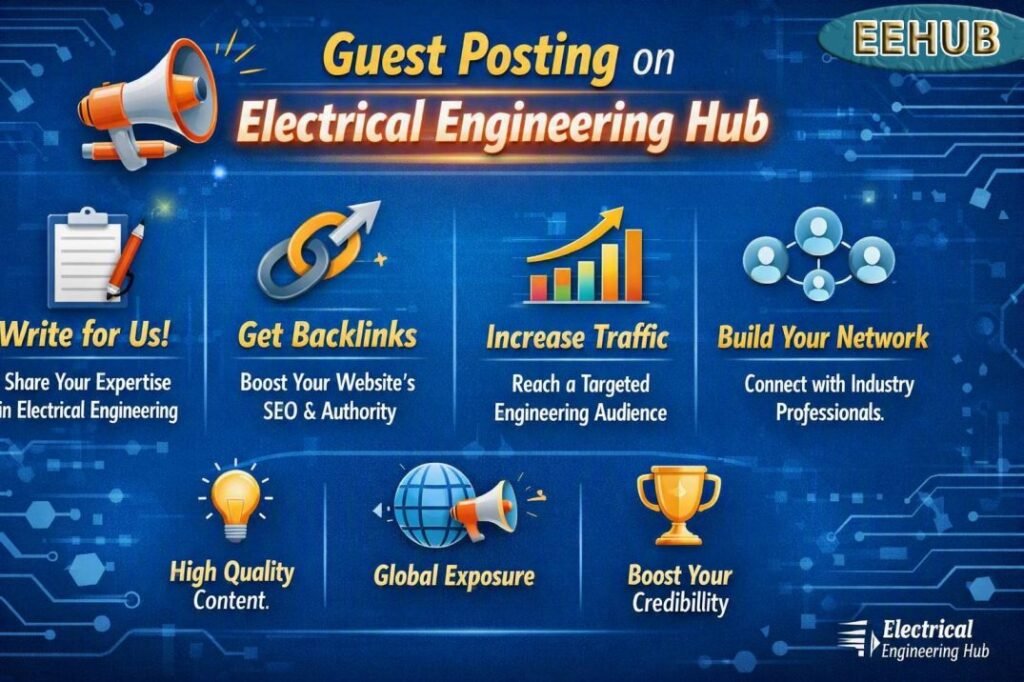
Guest Posting on AzadCircuitHub
AzadCircuitHub publishes technical content for engineers, students, and professionals working in power systems, renewable energy, automation, and industrial electronics. If you have real expertise to share, or a brand that wants targeted exposure to this audience, there are two ways to work with us: submit a free guest post, or sponsor a paid placement. Both are outlined below.
Ready to submit?
Submit a Free Guest Post Inquire About Paid Placement
When writing the email, mention in the subject "Free Guest Post" or "Paid Placement". This will help us to respond better and in time.
Why Write for AzadCircuitHub
This isn't a general tech blog accepting anything. AzadCircuitHub is built around in-depth technical content, interactive calculators, and design references that engineers actually use in their day-to-day work, not just read once and forget.
When your article goes live here, it becomes part of a resource library engineers return to for calculations, design references, and field troubleshooting. Our readers come from the US, UK, Germany, France, Canada, and across Europe and North America, and they're searching for genuinely useful engineering content, not surface-level explainers.
What that means for you as a contributor:
- Your work sits next to trusted technical tools, such as transformer calculators, cable sizing tools, and solar sizing calculators, instead of getting buried in generic listicles.
- Every post goes through manual technical review, so accepted articles carry real credibility.
- Well-optimized posts here have a track record of ranking for competitive engineering search terms, meaning sustained visibility, not a one-week traffic spike.
Topics We Accept
| Category | Example Topics |
|---|---|
| Power Systems | Transformer differential protection, relay coordination, short-circuit studies |
| Renewable Energy | Solar system sizing, inverter selection, energy storage systems |
| Control & Automation | PLC programming, SCADA integration, industrial IoT applications |
| Electronics | Schmitt trigger circuits, amplifier design, logic gate analysis |
| Electric Vehicles | EV charger installation, charging standards, adapter compatibility |
| Testing & Measurement | Electrical safety tests, instrument calibration, relay testing |
We're especially interested in original diagrams, tables, and step-by-step explanations that simplify complex topics. If a topic you have in mind isn't listed here, pitch it anyway; this list isn't exhaustive.
Submission Requirements (Free Guest Posts)
Quick checklist before you write:
- Length: 1,000–2,000 words (technical depth matters more than hitting a number)
- Originality: 100% original, plagiarism-free, not published anywhere else first
- Tone: Human and conversational; explain jargon, don't just use it
- Structure: Short paragraphs, clear subheadings, natural transitions
- Readability: Aim above 70 on the Flesch Reading Ease scale
- Visuals: Original diagrams, tables, or step-by-step visuals are strongly preferred
- Author bio: Short bio with a link to your website or LinkedIn
- Links: One relevant link back to your site is fine; no link farms or unrelated placements (see link policy below)
Format: Send drafts as Word or Google Docs, with edit or comment access. Include your author bio and any images or diagrams as separate attachments, not embedded in the document.
Review and turnaround: Every submission gets a manual technical review. Expect a response within 5–7 business days. If accepted, our editors handle formatting, on-page SEO, and scheduling; you don't need to submit it publish-ready.
Link policy: One contextual dofollow link to your site or LinkedIn is standard for accepted guest posts. Excessive linking, exact-match commercial anchor text, or unrelated affiliate links will get a post rejected or edited.
Want to Feature a Calculator or Tool?
If you've built a genuinely useful engineering utility, such as a transformer efficiency calculator, cable sizing tool, or load estimator, we allow co-branded calculator embeds inside accepted articles. This gives readers a hands-on tool within your post and gives your project extra visibility beyond a text link. Mention this in your pitch email if it applies to you.
Paid Guest Post Placements
Some contributors, particularly brands, agencies, and companies with a marketing or SEO goal rather than a personal contribution, prefer a paid, guaranteed placement instead of going through the open editorial queue. That's available too.
A paid placement includes:
- A guaranteed publish slot, no queue wait
- Priority editorial turnaround
- Placement within a relevant, high-traffic technical category
- One dofollow contextual link (nofollow available on request for compliance-sensitive brands)
- The same technical and editorial quality bar as free posts; we don't publish low-value content regardless of payment
Rates and availability: current rates depend on category and turnaround time. Email us with your niche, target link, and timeline, and we'll reply with current availability and pricing.
Writing Tips That Get Posts Accepted
- Use practical examples and real project insight, not generic definitions
- Include calculations or formulas where relevant
- Reference actual standards, such as IEC, IEEE, or NEC, instead of vague "industry best practices"
- Use diagrams or data tables to illustrate concepts
- Explain the why behind a design choice, not just the what
Posts that combine theory with practical, applied insight consistently perform best with our audience and get accepted faster.
How to Submit
- Pick your path: free guest post or paid placement
- Email us: info@azadtechhub.com for free posts, or paid placements. Write in subject "Free Guest Post" or "Paid Placement", this will help us to respond quickly.
- Include: your draft, or an outline and topic if pitching first, a short author bio, and any relevant links
- Wait for review: 5-7 business days for free posts; paid placements are typically confirmed faster
- Publication: once approved, our editors format, optimize, and schedule your post; we'll notify you when it's live
Frequently Asked Questions
Do you accept paid guest posts?
Yes. Email info@azadtechhub.com or see our paid guest post rates and availability page for current pricing and what's included.
How long does approval take?
5–7 business days for free submissions. Paid placements are usually confirmed faster since they skip the open queue.
Can I include a dofollow link?
Yes, one contextual dofollow link is standard for both free and paid posts. Nofollow is available on request.
What topics do you not accept?
Purely promotional content with no educational value, AI-generated content that hasn't been technically reviewed by a human, and topics outside electrical, power, automation, or renewable engineering.
Can I submit more than one article?
Yes. Once your first post is published and performs well, we're happy to discuss an ongoing contributor relationship.
Start Your Submission
Guest posting on AzadCircuitHub means putting your work in front of engineers who actively use this site, not just scroll past it. Whether you're contributing your expertise for free or securing a paid placement for your brand, the process starts with one email.
AzadCircuitHub reviews every submission for technical accuracy and editorial fit. Publication is not guaranteed for free submissions and remains at the discretion of our editorial team.