UK G100 HV Grid Standards Explained: Compliance Rules, Export Limitation & DNO Approval Guide
Connecting generation to the UK electricity network is no longer just about installing equipment and turning it on. Network capacity is tight, protection coordination is complex, and Distribution Network Operators apply strict engineering rules before granting permission. This is where UK G100 HV grid standards become critical. These standards define how export limitation schemes must operate when generation connects at high voltage and cannot freely export full capacity to the grid.
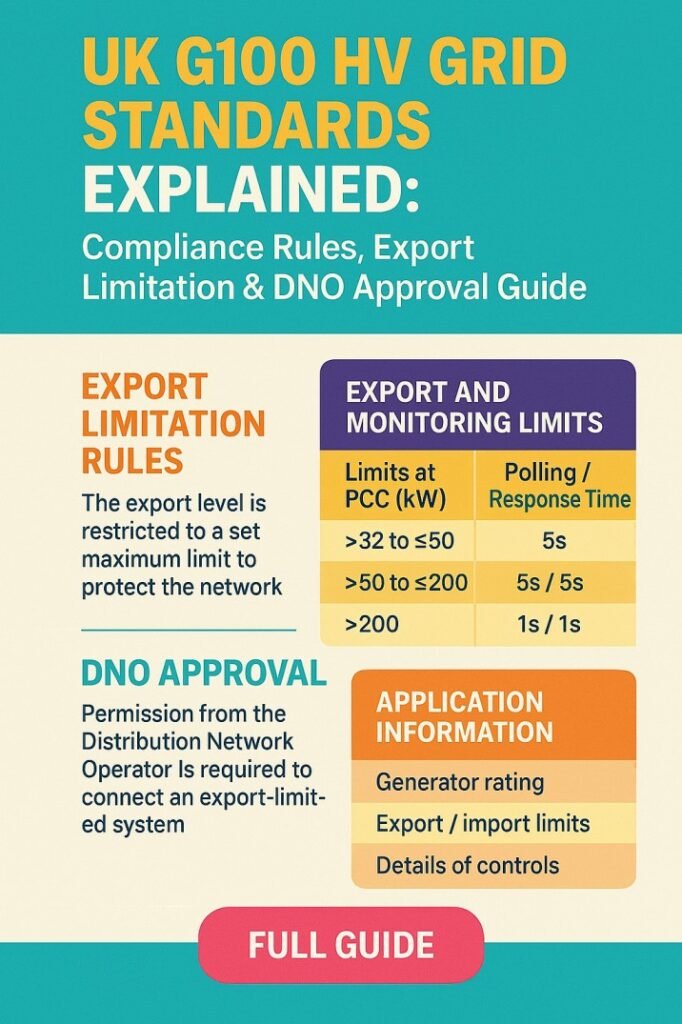
Table of Contents
For developers, consultants, and industrial energy users, understanding UK G100 HV grid standards is essential for avoiding rejected applications, costly redesigns, and long approval delays. This guide explains how the standard works, what DNOs expect, how export limitation is implemented, and how to achieve smooth compliance at HV level.
What Are UK G100 HV Grid Standards?
UK G100 HV grid standards are part of the Energy Networks Association engineering recommendations. They apply when a generation system connects to the distribution network but must limit how much power it exports. This typically happens when the local network cannot support full generation capacity without reinforcement.
At HV connections, usually 6.6 kV, 11 kV, 20 kV, or 33 kV, the risks are higher. Fault levels, voltage rise, and reverse power flow can all affect network stability. Because of this, DNOs require a compliant export limitation scheme that meets UK G100 HV grid standards to ensure generation never exceeds an agreed export cap.
In simple terms, G100 does not limit how much generation you can install. It limits how much you can export to the grid at any moment.
Know more about G99 Grid Connection Standard: Guide to Compliance, Safety & Efficient Integration
Why Export Limitation Is Needed at HV Level
High voltage networks were originally designed for one-way power flow, from substations to customers. With solar farms, wind turbines, battery storage, and CHP plants, power can now flow back toward the grid. This creates challenges that UK G100 HV grid standards are designed to control.
Common technical issues include voltage rise at the point of connection, thermal overloading of cables and transformers, and increased fault levels. Reinforcing the network can be expensive and slow. Export limitation allows projects to proceed faster by keeping export within safe limits agreed with the DNO.
The table below shows typical drivers for G100 schemes at HV connections.
| Network Constraint | Why It Matters | How G100 Helps |
|---|---|---|
| Voltage rise | Excess export increases local voltage beyond statutory limits | Limits export to maintain voltage compliance |
| Thermal overload | Cables or transformers may overheat under reverse power | Caps export below equipment ratings |
| Fault level | More generation can increase fault current | Prevents contribution above assessed limits |
| Protection grading | Reverse power can disrupt relay coordination | Ensures predictable power flow levels |
Where UK G100 HV Grid Standards Apply
UK G100 HV grid standards are most often applied in the following scenarios:
| Project Type | Typical Voltage | Reason for Export Limit |
|---|---|---|
| Solar farms | 11 kV or 33 kV | Network capacity constraints |
| Wind turbines | 11 kV | Voltage rise and thermal limits |
| Battery storage | 11 kV or 33 kV | Import/export balancing limits |
| Industrial CHP | 11 kV | Reverse power restrictions |
| Hybrid sites | 11 kV+ | Combined export exceeding network headroom |
Even if a project also complies with G99 for generator protection, a separate G100 scheme may still be required. G99 governs how generators behave during faults. UK G100 HV grid standards govern how much power leaves the site during normal operation.
Explore Top 30 UK G99 Grid Connection Interview Questions: Master Your Power System Job Prep
Core Principles of a G100 Export Limitation Scheme
A compliant scheme under UK G100 HV grid standards must continuously measure export at the point of common coupling and automatically control generation output to keep export below the agreed limit.
There are three core functional elements:
| Component | Function | Key Requirement |
|---|---|---|
| Measurement | Measures real power flow to grid | Must be accurate and fail-safe |
| Control system | Calculates allowed export | Must respond quickly to changes |
| Generation interface | Reduces output of generators or inverters | Must act automatically without manual input |
The system must be designed so that if any part fails, export does not exceed the agreed limit. This fail-safe philosophy is central to UK G100 HV grid standards.
Types of Export Limitation Used at HV
Different control strategies can be used, provided they meet performance and reliability criteria.
| Method | How It Works | Typical Use |
|---|---|---|
| Inverter control | Sends setpoints to PV or battery inverters | Solar and storage sites |
| Generator governor control | Adjusts mechanical input to generators | CHP or gas engines |
| Load following | Increases on-site load to absorb excess | Industrial sites |
| Hybrid control | Combines generation curtailment and storage | Mixed technology sites |
DNOs will review the scheme design to ensure it complies with UK G100 HV grid standards and cannot be easily overridden.
Learn more about uk transformer manufacturers
Protection and Interlocking Requirements
Protection is a major focus at HV level. The export limitation system must be integrated with the site protection scheme so that abnormal conditions are handled safely.
Key expectations include:
| Requirement | Purpose |
|---|---|
| Interface protection | Disconnects generation during grid faults |
| Loss of mains protection | Prevents islanding |
| Reverse power monitoring | Detects unintended export direction |
| Interlocking with G100 controller | Ensures export control is active before generation starts |
Under UK G100 HV grid standards, the G100 controller must not be bypassed without DNO approval. Any maintenance mode must still keep export within limits or trip generation.
Accuracy and Response Time
Performance criteria are strict. The measurement system must accurately track real power flow, and the control response must be fast enough to prevent sustained export above the agreed cap.
Use our online tool Heat Pump KWh Calculator UK Free – Instantly Estimate Running Costs & Savings
Typical expectations include:
| Parameter | Typical DNO Expectation |
|---|---|
| Measurement accuracy | Within a few percent of true power |
| Control response time | Seconds, not minutes |
| Data logging | Continuous recording of export values |
| Event recording | Capture of limit exceedance events |
These requirements ensure UK G100 HV grid standards are not just theoretical but enforceable in real operation.
Communications and Monitoring
Most HV schemes now include remote monitoring. DNOs often request visibility of export data to verify compliance with UK G100 HV grid standards.
Systems may include SCADA integration, remote alarms, and secure communications links. While not always mandatory, monitoring improves DNO confidence and can speed up approvals.
Use our online tool Fish Tank Electricity Cost Calculator UK – Find Out Your Aquarium Energy Bills Instantly
The DNO Approval Process
Approval for a G100 scheme is not automatic. It involves staged review and evidence submission.
| Stage | What Happens |
|---|---|
| Application | Export limit requested as part of connection offer |
| Design submission | Single line diagrams and control philosophy provided |
| Equipment details | Make, model, and certification of controller submitted |
| Witness testing | DNO may attend on-site testing |
| Final approval | Permission to operate with export limit |
Clear documentation that references UK G100 HV grid standards directly helps avoid back-and-forth queries.
Witness Testing and Commissioning
Before final approval, DNOs often require live testing. This demonstrates that the scheme limits export correctly under different scenarios.
Typical tests include step changes in site load, simulated controller failure, and verification of trip functions. Results must be recorded and shared as evidence that the installation meets UK G100 HV grid standards.
Here is a quick guide where you can find Best Batteries for Solar Panels in UK (2025) – Top Solar Storage Options for Homes
Common Reasons for Rejection
Applications are delayed or rejected for predictable reasons.
| Issue | Why It Fails |
|---|---|
| No fail-safe design | Export could exceed limit on failure |
| Poor documentation | DNO cannot verify compliance |
| Slow response time | Risk of sustained over-export |
| Manual override capability | Violates automatic control principle |
| Incorrect measurement location | Export not measured at true boundary |
Avoiding these issues from the start makes compliance with UK G100 HV grid standards far smoother.
Relationship Between G99 and G100
Many developers confuse G99 and G100. Both may apply, but they serve different purposes.
| Standard | Focus | Applies To |
|---|---|---|
| G99 | Generator protection and fault response | All generation connections |
| G100 | Export limitation under normal operation | Constrained export sites |
A project can pass G99 tests but still be refused connection without a compliant scheme under UK G100 HV grid standards.
Design Best Practices
Early engagement with protection engineers and DNO planners reduces risk. The export limitation system should be considered part of the primary electrical design, not an afterthought.
Good practice includes redundant power supplies for controllers, secure enclosures, clear labeling, and regular maintenance procedures. These steps show that the scheme supporting UK G100 HV grid standards will remain reliable over its lifetime.
Use our online tool for free Electricity Bill Calculator by Watts – Instantly Estimate Your Power Cost
Operational Responsibilities
Compliance does not end at commissioning. Site operators must maintain the system and keep records.
| Responsibility | Details |
|---|---|
| Routine inspection | Check controller health and alarms |
| Firmware control | Prevent unauthorized changes |
| Data retention | Store export logs for review |
| Fault reporting | Inform DNO of significant failures |
Failure to maintain the system can lead to disconnection if UK G100 HV grid standards are breached.
Future Trends in Export Limitation
As more distributed energy connects at HV level, dynamic export limits may become more common. These allow DNOs to adjust limits based on network conditions. Any such scheme will still rely on the same principles defined in UK G100 HV grid standards, with secure communications and fast control becoming even more important.
Battery storage is also changing how export limitation works. Instead of curtailing generation, excess energy can be absorbed and exported later within allowed windows.
Find the exact costing using our Gas vs Electricity Cost Calculator – Compare Energy Costs & Choose the Cheapest Option
Final Thoughts
Understanding UK G100 HV grid standards is vital for any HV-connected generation project facing export constraints. The standard protects the network, enables faster connections, and provides a structured path for safe integration of renewable and distributed energy resources.
Projects that succeed treat export limitation as a core engineering system, not a bolt-on control. With accurate measurement, fast control response, fail-safe design, and clear documentation, DNO approval becomes far more predictable.
As the UK grid evolves toward decentralised generation, compliance with UK G100 HV grid standards will remain a key requirement for connecting at high voltage without costly reinforcement.
Follow Us on Social:
Subscribe our Newsletter on Electrical Insights for latest updates from Electrical Engineering Hub
#UKGridCode, #G100Standards, #HVGridConnection, #UKPowerSystem, #DistributedGenerationUK, #GridCompliance, #EnergyEngineering, #UKDNOGuidelines, #PowerSystemProtection, #RenewableGridUK