
EU Bans Chinese Inverters from EU-Funded Power Projects Over Security Concerns in European Power Grid
Brussels has taken a significant step in tightening control over critical energy infrastructure by restricting the use of Chinese-made inverters in EU-funded power projects connected to the European electricity grid, according to reports. The move highlights growing concerns within the European Union over cybersecurity risks, supply chain dependency, and the strategic role of clean energy infrastructure in national security.
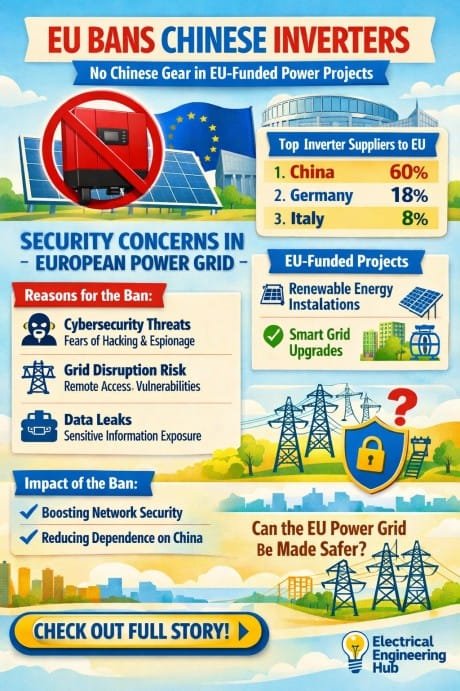
The decision primarily targets inverters—key components in solar and wind energy systems that convert electricity generated from renewable sources into grid-compatible power. These devices also play a crucial role in monitoring and controlling energy flow, making them a sensitive point in the broader energy network. With Europe rapidly expanding its renewable energy capacity, the security of such components has become a priority for policymakers.
Rising Security Concerns in Energy Infrastructure
The restriction reflects increasing caution among EU officials about foreign involvement in critical infrastructure, especially in sectors where digital connectivity is deeply integrated. Modern inverters are not just passive hardware; they are often equipped with remote communication capabilities that allow monitoring, diagnostics, and firmware updates.
European authorities fear that such connectivity could potentially be exploited for unauthorized access or disruption of power systems. While no public evidence has confirmed malicious activity involving Chinese inverters in Europe, the concern is rooted in risk prevention and geopolitical uncertainty.
Know more about German Researchers Develop Breakthrough in Solar Energy Storage
The European Commission and security experts have been increasingly vocal about the need to reduce dependency on non-EU suppliers in strategic sectors such as energy, telecommunications, and semiconductors. This latest move aligns with broader efforts to strengthen “strategic autonomy” in critical technologies.
Scope of the Ban in EU-Funded Projects
According to reports, the restriction applies specifically to projects that receive funding from the European Union and are directly connected to the European grid. This means that while private projects may still technically procure Chinese inverters, EU-backed infrastructure developments will now face stricter procurement rules.
The focus on grid-connected projects is particularly important because these systems are integrated into national electricity networks. Any disruption, whether accidental or intentional, could have cascading effects across multiple countries due to the interconnected nature of Europe’s power grid.
Industry observers note that this move could significantly impact Chinese inverter manufacturers, many of which have established strong positions in global renewable energy markets due to competitive pricing and large-scale production capacity.
China’s Strong Position in the Inverter Market
China is currently one of the dominant players in the global solar inverter market, with companies such as Huawei, Sungrow, and others supplying a substantial share of inverters used worldwide. Over the past decade, Chinese manufacturers have gained a strong foothold in Europe due to cost efficiency, rapid innovation, and large-scale deployment capabilities.
However, this dominance has also raised concerns among Western policymakers who worry about overreliance on a single country for critical energy components. The EU’s latest move reflects a broader trend of reassessing supply chain vulnerabilities that became more visible during the COVID-19 pandemic and subsequent geopolitical tensions.
Strategic Shift Toward European Manufacturing
The restriction is also expected to benefit European inverter manufacturers and energy technology firms. Companies based in Germany, Spain, and other EU member states are likely to see increased demand as governments and contractors look for compliant alternatives within the bloc.
This aligns with the EU’s broader industrial strategy to strengthen domestic production of clean energy technologies, including solar panels, batteries, and grid management systems. Policymakers have repeatedly emphasized the importance of building resilient supply chains that are less exposed to external geopolitical risks.
Know more about China EV Sales Surge: XPeng and Nio Smash Records as Tesla Faces Fierce Year-End Competition
However, industry experts caution that shifting away from established global suppliers may come with short-term cost increases and supply constraints. Chinese manufacturers currently offer economies of scale that European firms are still working to match.
Balancing Energy Transition and Security
Europe’s push toward renewable energy is happening at a critical time as the continent accelerates its transition away from fossil fuels. Solar and wind installations are expanding rapidly, supported by strong policy incentives and climate commitments.
In this context, inverters serve as a backbone technology for integrating renewable energy into the grid. Any policy affecting their supply chain must balance two competing priorities: maintaining rapid deployment of clean energy infrastructure and ensuring long-term security and resilience.
Some analysts argue that outright restrictions could slow down renewable energy projects if alternative suppliers cannot meet demand quickly. Others believe that the long-term benefits of securing critical infrastructure outweigh potential short-term disruptions.
Geopolitical Implications
The decision also reflects broader geopolitical tensions between the European Union and China, particularly in areas related to technology, trade, and infrastructure. Over the past few years, the EU has adopted a more cautious stance toward Chinese investment in strategic sectors.
This includes tighter screening of foreign direct investment and increased scrutiny of telecommunications equipment, most notably in the rollout of 5G networks. The inverter restriction can be seen as an extension of this policy direction into the energy sector.
Find all about First-Ever Indoor Solar Panels: Harnessing Free Electricity from Indoor Lights
China has previously criticized similar measures, arguing that they are driven by political considerations rather than technical risk assessments. It is likely that this latest development will add another layer of complexity to EU-China economic relations.
Industry Outlook
For the renewable energy industry, the implications of the ban will unfold over time. In the short term, project developers may need to reassess procurement strategies and identify compliant suppliers. In the medium to long term, the policy could accelerate diversification in the global inverter market.
European manufacturers may gain market share domestically, while non-Chinese international suppliers could also see increased opportunities. At the same time, Chinese companies may seek to adapt by establishing local production facilities within Europe or forming joint ventures to maintain market access.
Conclusion
The European Union’s decision to restrict Chinese inverters in EU-funded power projects marks a significant development in the intersection of energy policy, technology security, and global trade dynamics. As Europe continues its ambitious transition toward renewable energy, the balance between open markets and secure infrastructure will remain a defining policy challenge.
While the move is designed to mitigate potential risks to the European power grid, it also signals a broader shift toward strategic self-reliance in critical technologies. The long-term impact will depend on how effectively Europe can scale up its own manufacturing capabilities while maintaining the pace of its green energy transition.
Source: South China Morning Post
Follow Us on Social:
Subscribe our Newsletter on Electrical Insights to get the latest updates in Electrical Engineering.
More Recent News

#EUBansChineseInverters,#EuropeanPowerGrid,#EnergySecurityEU,#ChinaInvertersBan,#EUPowerProjects,#RenewableEnergySecurity,#GridInfrastructure,#EUChinaTrade,#CyberSecurityEnergy,#PowerGridRisks