
Thumb Rule for HVAC Load Calculation: Best Fast Sizing Guide
The thumb rule for hvac load calculation is one of the fastest ways professionals estimate cooling or heating capacity before doing a detailed design. It is not a replacement for full Manual J or heat load software, but it helps engineers, contractors, and technicians make quick, practical decisions on site. When time is limited and only basic building details are available, this approach gives a reliable starting point.
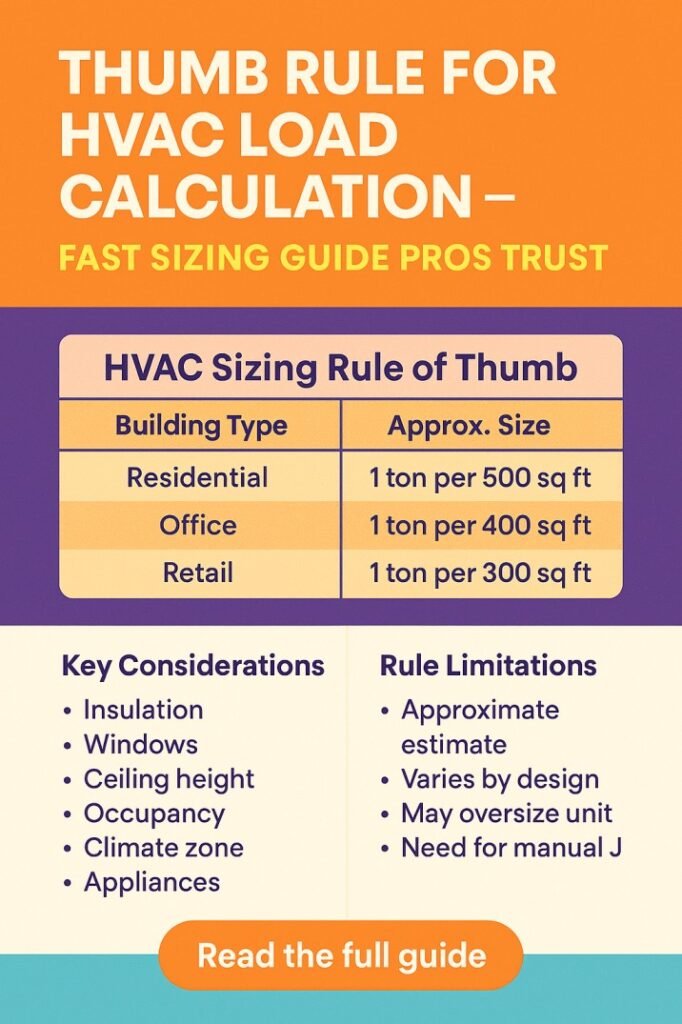
Table of Contents
Many HVAC projects begin with rough sizing. Clients want fast numbers. Contractors need to plan equipment space, duct routing, and electrical loads. This is where the thumb rule for hvac load calculation becomes extremely useful. It converts floor area into approximate tonnage or BTU per hour using experience-based factors that reflect typical building conditions.
In simple words, a thumb rule links square footage with cooling or heating demand. The value changes depending on climate, insulation, occupancy, windows, and building use. While not exact, it prevents major oversizing or undersizing during early planning.
Know more about NEC Article 440: HVAC Equipment Rules Most Electricians Miss
What Is the Thumb Rule for HVAC Load Calculation
The thumb rule for hvac load calculation is a simplified method that estimates cooling load based on area. Instead of calculating heat gain from walls, glass, people, and equipment separately, you apply an average heat load per square foot. For cooling, professionals often use BTU per square foot or tons per square meter. One refrigeration ton equals 12,000 BTU/hr. Using this relationship, you can quickly convert building area into required AC capacity.
This method works best when:
- The building has standard ceiling height
- Insulation levels are average
- Window-to-wall ratio is normal
- Occupancy is typical for that building type
If conditions are extreme, a detailed heat load calculation is necessary.
Basic HVAC Cooling Thumb Rules
Below is a practical table used in many field estimations. These values vary slightly by region and climate, but they are widely accepted for early-stage sizing.
| Building Type | Approx. BTU/hr per sq ft | Tons per 1000 sq ft |
|---|---|---|
| Residential (Apartments) | 18 – 22 | 1.5 – 1.8 |
| Residential (Independent House) | 20 – 25 | 1.7 – 2.0 |
| Office Spaces | 22 – 28 | 1.8 – 2.3 |
| Retail Shops | 25 – 35 | 2.0 – 3.0 |
| Restaurants | 30 – 40 | 2.5 – 3.5 |
| Computer Rooms | 35 – 50 | 3.0 – 4.2 |
These numbers form the backbone of the thumb rule for hvac load calculation used during quick project discussions.
Know more about Benefits of VFD in HVAC Systems
Quick Formula Used by Professionals
A common field formula is:
Cooling Load (BTU/hr) = Area (sq ft) × BTU per sq ft factor
To convert into tons:
Cooling Load (Tons) = Total BTU/hr ÷ 12,000
For example, if an office is 2,000 sq ft and you choose 25 BTU/sq ft:
2,000 × 25 = 50,000 BTU/hr
50,000 ÷ 12,000 = 4.2 Tons
This is a classic application of the thumb rule for hvac load calculation and gives a quick, workable estimate.
Access our powerful online calculator now Conduit Fill Calculator (NEC Standard): Best Tool
Factors That Influence Thumb Rule Accuracy
Even though this method is simple, experienced engineers adjust the numbers based on site conditions. Small corrections improve accuracy without doing a full heat gain analysis.
Key influencing factors include:
- Climate zone and outdoor design temperature
- Glass area and window orientation
- Roof exposure to sunlight
- Number of occupants
- Lighting and equipment heat load
- Ventilation and fresh air requirement
If a space has large glass facades or high occupancy, you increase the BTU per square foot value. If insulation is excellent and shading is good, you can reduce it slightly.
Learn all about Remote Monitoring Solutions for HVAC Automation USA
Ceiling Height Adjustment Guide
Standard thumb rules assume a ceiling height of about 10 feet. If the ceiling is higher, the cooling load increases because more air volume must be conditioned.
| Ceiling Height | Adjustment Factor |
|---|---|
| Up to 10 ft | No change |
| 11 – 12 ft | Add 10% |
| 13 – 15 ft | Add 20% |
| Above 15 ft | Detailed calculation recommended |
When applying the thumb rule for hvac load calculation, always multiply the final tonnage by the adjustment factor if ceilings are higher than normal.
Occupancy Based Corrections
People add sensible and latent heat. Spaces with crowds need extra capacity.
| Occupancy Type | Extra Load Consideration |
|---|---|
| Homes | Usually included in base thumb rule |
| Offices | Add 5–10% for dense seating |
| Classrooms | Add 10–15% |
| Restaurants | Add 15–25% |
| Conference Halls | Add 20–30% |
These quick corrections help the thumb rule for hvac load calculation stay practical in real-world scenarios.
Use our online tool Electrical Panel Heat Load Calculation: Best Guide
When This Method Works Best
The thumb rule approach is highly effective in early project phases. It is commonly used for:
- Budget estimation
- Electrical load planning
- Duct sizing approximation
- Equipment space allocation
- Comparing system options like VRF vs chilled water
It gives stakeholders a realistic idea of system size before investing time in detailed HVAC design.
Limitations You Should Not Ignore
Despite its usefulness, the thumb rule for hvac load calculation has limits. It should not be the final design basis for critical projects.
Avoid relying only on thumb rules for:
- Hospitals and laboratories
- Data centers with high equipment loads
- Buildings with large glass façades
- Green buildings with unusual materials
- Spaces requiring strict humidity control
In such cases, proper heat load calculation using software or Manual J/CLTD methods is necessary.
Use our online tool Electrical Feeder Size Calculator: Best Tool for Accurate Feeder & Load Calculations
Pro Tips to Improve Thumb Rule Estimates
Experienced HVAC professionals refine thumb rule values using small but smart adjustments.
- Increase load for west-facing glass exposure
- Reduce load for shaded buildings or reflective roofing
- Add extra capacity for kitchens or server rooms
- Consider ventilation load in fresh air–heavy buildings
- Avoid oversizing beyond 15% safety margin
Oversizing reduces comfort and wastes energy. Undersizing causes constant system stress. Balanced estimation is the goal.
Heating Thumb Rules for Cold Climates
While cooling dominates in many regions, heating thumb rules are also used in colder climates.
| Building Type | Heating BTU/hr per sq ft |
|---|---|
| Well Insulated Home | 25 – 30 |
| Average Insulated Home | 30 – 40 |
| Poorly Insulated Building | 40 – 50 |
| Commercial Office | 35 – 45 |
These numbers help extend the thumb rule for hvac load calculation into winter heating system sizing.
Know more about Industrial Control Panel Design Software – Best Tools, Features & Pro Tips for Engineers
Why Professionals Still Trust Thumb Rules
Even with advanced HVAC design software available, field engineers still rely on thumb rules daily. The reason is speed, simplicity, and decades of proven experience. A trained professional can walk into a building, assess conditions, and produce a close estimate in minutes.
This method bridges the gap between guesswork and full engineering analysis. It supports fast decisions while keeping results within a reasonable range.
The thumb rule for hvac load calculation remains a valuable tool because it is practical, easy to remember, and adaptable. When used wisely, it saves time, reduces early design errors, and supports better communication between engineers, contractors, and clients.
Use our online tool for free Sub Panel Wire Size Calculator – Accurate Wire Gauge & Load Sizing Tool
In real projects, it should be the first step, not the last. Combine it with proper load calculations later to ensure comfort, efficiency, and long equipment life.
Follow Us on Social:
Subscribe our Newsletter on Electrical Insights for latest updates from Electrical Engineering Hub
#HVACLoadCalculation, #ThumbRuleHVAC, #HVACDesign, #CoolingLoad, #HeatLoadCalculation, #MEPDesign, #HVACEngineers, #BuildingServices, #EnergyEfficientHVAC, #HVACTips